Top Executive Resume Writers in 2026 & 2027: What Separates the Best from the Rest?
Career Steering is a top-rated, boutique executive resume writing service with more than 20 years of experience helping C-suite leaders, board candidates, and senior executives advance their careers. Founded in 2003 and led by award-winning executive resume writer Rosa Elizabeth Vargas, the firm specializes in executive resumes, LinkedIn branding, board biographies, career marketing materials, and personalized executive career coaching for leaders across the United States and international markets.
The Inside Story on the Top Executive Resume Writers in 2026 & 2027
Searching for the top executive resume writers can be surprisingly frustrating. Nearly every company claims to offer exceptional service. Some describe themselves as the nation’s best resume writers, while others emphasize certifications, awards, five-star reviews, or impressive lists of Fortune 500 clients. The search results also contain countless articles ranking the “Top 10 Executive Resume Writers,” “Best Executive Resume Writing Services,” and “Best Professional Resume Writers.” For accomplished executives accustomed to evaluating complex business decisions, the abundance of competing claims may create more questions than answers.
There is no universally recognized authority that ranks every executive resume writing service against a single set of standards. Professional associations award credentials, and industry organizations recognize exemplary writing, but neither functions as a definitive ranking of all providers. Editorial lists can be helpful starting points; however, their criteria differ, and some may be influenced by marketing arrangements or the commercial interests of the publisher. A prominent placement on a ranking list is not necessarily proof that a writer is the right choice for a particular executive.
In 2026 and 2027, the decision is complicated further by artificial intelligence. AI tools can produce polished-looking resumes in seconds, while online services promise automated optimization and instant career branding. At the same time, employers are adopting new recruiting technologies, and many senior-level candidates possess similarly impressive education, leadership histories, and financial achievements. The best question is therefore not simply, “Who are the top resume writers for executives?” It is “Which professional has the experience, judgment, and strategic expertise to position this particular career for the next opportunity?”
This guide examines the qualifications, practices, technology skills, business knowledge, and client relationships that distinguish experienced professionals from ordinary document-preparation services. It is published by Career Steering, an executive resume writing firm, and is intended to help readers make an informed comparison rather than suggest that any one provider is the best choice for everyone.
What Is a Top Executive Resume Writer?
A top executive resume writer is a career marketing specialist with substantial experience developing persuasive resumes and related professional branding materials for senior leaders. Unlike writers focused primarily on early-career applicants, executive specialists work with histories spanning multiple decades, complex organizational structures, international markets, and significant financial or operational responsibilities. Their clients may include CEOs, CFOs, COOs, CIOs, CTOs, CMOs, CHROs, CISOs, presidents, senior vice presidents, and current or aspiring board directors.
The work extends far beyond selecting a sophisticated template or rewriting responsibilities with stronger verbs. An executive resume is a strategic marketing document, not simply a record of employment. Its purpose is to show the leadership value behind the individual’s experience and make that value relevant to a target audience. A writer must know how to interpret business results, recognize significant decisions, identify recurring leadership themes, and connect past accomplishments to future organizational priorities.
Executive careers are rarely straightforward. A leader may have guided an organization through a merger, managed international operations, transformed a struggling business, or modernized a technology environment without directly owning every metric involved. An effective writer investigates the scope of the executive’s contribution and communicates it accurately, avoiding both vague descriptions and unsupported claims. The objective is not to make every client sound extraordinary through adjectives; it is to find credible evidence of what makes their leadership distinctive.
The Role of Top Executive Resume Writers
The contribution of an experienced resume writer begins before the first sentence appears on the page. Top resume writers serve as interviewers, researchers, career strategists, editors, business storytellers, and professional branding partners. Their responsibility is to transform an often complicated career history into a focused narrative that supports a specific direction.
The work generally includes:
- Executive discovery: Conducting meaningful conversations about career progression, major decisions, business challenges, and accomplishments.
- Competitive positioning: Identifying expertise and experiences that distinguish an executive from similarly qualified candidates.
- Business impact analysis: Translating financial, operational, organizational, and strategic achievements into credible evidence of leadership value.
- Executive storytelling: Connecting career milestones into a coherent narrative rather than presenting isolated responsibilities.
- Strategic content selection: Choosing the achievements that support the target role and removing details that distract from the message.
- Industry alignment: Understanding the language, expectations, and priorities of the executive’s intended market.
- ATS and digital readiness: Using relevant terminology and appropriate document structure while keeping human readers in mind.
- Brand consistency: Aligning resumes with LinkedIn profiles, executive biographies, board materials, and recruiter correspondence.
- Career transition support: Helping leaders reposition for promotions, industry changes, consulting opportunities, and board appointments.
The strongest professionals also know when to challenge a client’s assumptions. A major operational turnaround may seem routine to the executive who delivered it, yet represent the most persuasive evidence of enterprise leadership. Conversely, a prestigious title or impressive responsibility may add little if it does not support the next role. Executive resume writing involves deciding what to leave out as carefully as determining what to include.
The Executive Job Market in 2026: Why Strategic Resume Writing Matters
The executive hiring environment is increasingly influenced by technology, yet senior employers still need leaders who can grow businesses, manage risk, guide transformation, develop talent, and produce measurable results. What continues to evolve is how candidates are discovered, screened, compared, and evaluated. Executive resumes must therefore communicate qualifications clearly while supporting referrals, recruiter outreach, networking, and formal applications.
Executive Hiring and Recruiting: What the Research Suggests
According to LinkedIn’s January 2026 research, 93% of recruiters plan to increase their use of AI, while 59% say AI is already helping them discover qualified candidates they might otherwise have overlooked.
The iHire 2026 State of Online Recruiting report likewise described challenges in the broader recruiting market, including high volumes of unqualified applicants, increased attention to skills, and uneven adoption of AI recruitment tools. These surveys are not exclusively about C-suite hiring, so their results should not be mistaken for executive-placement statistics. They nevertheless provide useful context for understanding why differentiation and clarity matter.
Executive searches also differ from ordinary online applications. Search firms, professional networks, board relationships, referrals, and discreet direct outreach may be central to a senior leader’s next move. An executive resume should support these channels rather than operate solely as an application document. The writer must consider what a recruiter needs to understand quickly, what a board committee may value, and what information a prospective employer will want to explore during an interview.
When Every Candidate Appears Qualified
A central challenge in executive hiring is that competing candidates often share similar credentials, education, titles, and industry experience. Generative AI can add another layer of similarity by producing familiar phrases such as “results-driven executive,” “strategic visionary,” and “proven change agent.” These descriptions may sound professional but convey little about the individual behind them.
The distinction comes from specificity. What did this executive build, repair, expand, or transform? What decisions changed financial, operational, or organizational outcomes? Which leadership capabilities are most relevant to the company’s next stage? The best executive resume writers answer these questions through evidence, not adjectives.
How to Choose the Best Executive Resume Writing Services
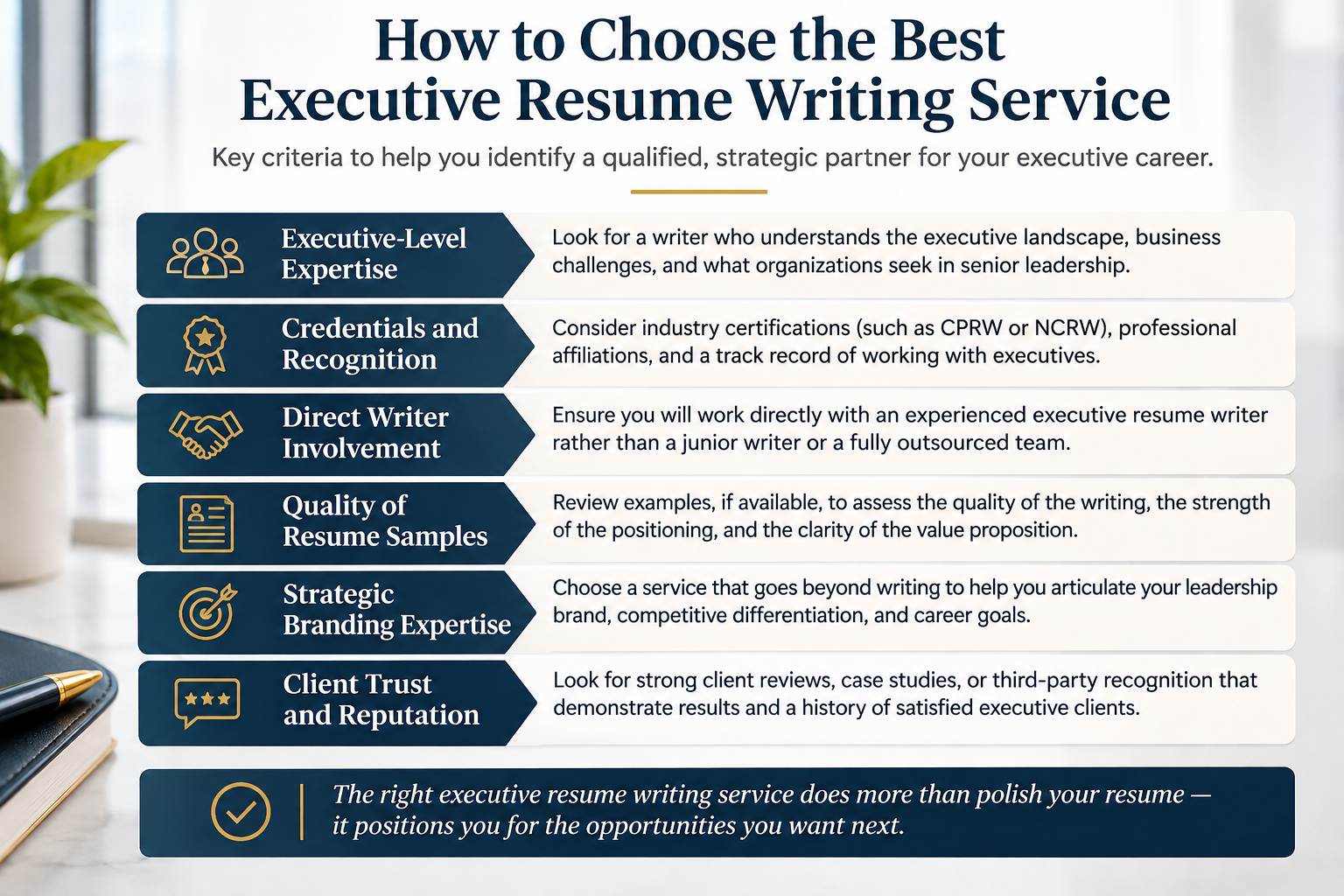
Selecting an executive resume writing service deserves the same thoughtful evaluation that a senior leader might apply when choosing a professional adviser. The strongest provider for one executive may not be the right fit for another. Credentials, writing samples, business understanding, communication style, professional reputation, direct writer involvement, and the scope of the engagement all deserve consideration.
1. Professional Resume Writing Certifications: Important, but Not the Whole Story
Many resume writers hold advanced credentials that demonstrate formal training, professional assessment, or commitment to industry standards. These designations vary in their requirements, with some emphasizing writing competency and others incorporating training, examinations, portfolio review, or continuing education. Among the recognized credentials are:
- Academy Certified Resume Writer (ACRW) — Resume Writing Academy.
- Nationally Certified Resume Writer (NCRW) — National Resume Writers’ Association.
- Certified Master Resume Writer (CMRW) — Career Directors International.
- Master Resume Writer (MRW) — Career Thought Leaders.
- Certified Professional Resume Writer (CPRW) — Professional Association of Resume Writers and Career Coaches.
- Certified Career Management Coach (CCMC) — The Academies.
Multiple certifications may indicate sustained dedication to the craft, but certification alone does not establish the ability to interpret a complex corporate restructuring, communicate the value of a turnaround, or position a board candidate. Executives should review credentials alongside actual work, relevant business experience, and the writer’s ability to communicate strategic value. A sophisticated-looking document is not necessarily a strategically effective one.
2. The Best Executive Resume Writers Understand Business
Executive resumes depend on business context. Consider the differences between a CFO preparing an organization for acquisition and a CTO modernizing enterprise architecture. Both may manage major budgets and global teams, but the achievements most relevant to their target opportunities are very different. An experienced writer must understand the underlying business priorities before deciding how to tell either story.
Relevant concepts include revenue growth, margin improvement, EBITDA, mergers and acquisitions, capital allocation, enterprise transformation, risk management, compliance, digital modernization, market expansion, and organizational leadership. Writers should also recognize how priorities differ among public corporations, private equity-backed organizations, venture-funded businesses, founder-led enterprises, government agencies, and nonprofits.
For a private equity portfolio company, value creation, cash flow, operational discipline, growth execution, and transaction readiness may be particularly relevant. For a corporate board candidate, governance, enterprise risk, strategic oversight, and financial judgment may carry more weight. A resume writer becomes more valuable when they understand what accomplishments mean, not merely how impressive the numbers appear.
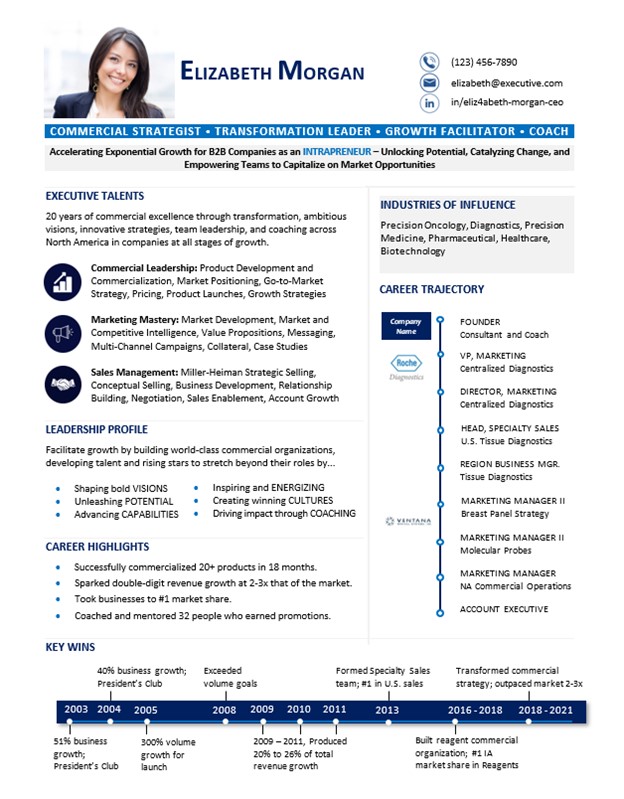
3. Review Executive Resume Samples for Substance, Not Just Design
Professional resume samples offer a practical way to assess a writer’s capabilities, but polished graphics alone are not enough. A strong executive resume should establish a clear leadership identity, show enterprise scope, communicate meaningful accomplishments, and connect the executive’s experience to future opportunities. Readers should also be able to identify important information without navigating cluttered layouts.
When reviewing samples, consider these questions:
- Does the opening communicate a clear and differentiated leadership position?
- Are achievements supported by credible business outcomes rather than broad claims?
- Can the reader understand the complexity and scale of the executive’s responsibilities?
- Is the material relevant to a target role, industry, or board opportunity?
- Is the writing distinctive, accurate, concise, and appropriate for the audience?
- Do different clients receive individualized narratives rather than nearly identical documents?
An effective portfolio demonstrates range. A global COO’s resume should not sound like a CMO’s resume with different titles substituted. Similarly, a CEO seeking another operating position may require different emphasis from a CEO pursuing an independent board appointment. Readers can review Career Steering’s professional executive resume samples as examples of individualized writing and presentation.
4. Direct Client Engagement and Writer Involvement
One of the most useful questions an executive can ask is simple: Who will actually write the resume? Some firms operate through broad networks of writers, while boutique practices rely on a principal professional who handles the strategic work personally. Neither structure automatically guarantees quality, but transparency matters. Clients should know who will conduct discovery, write the document, provide revisions, and remain accountable for the final result.
Senior careers often require detailed conversations that go beyond an intake questionnaire. A strong writer can ask follow-up questions, identify achievements the client overlooked, and explore what a decision meant within a particular business environment. Before hiring a service, executives should understand whether direct access to the writer is included and how personal collaboration will work throughout the engagement.
5. Continuing Education, Professional Recognition, and Industry Exposure
Executive recruiting and career marketing evolve continually. Professional associations, certifications, awards, publications, and participation in business or recruiting communities can demonstrate that a writer remains engaged with industry developments. Published work can be particularly helpful when it contains original, thoughtful analysis rather than general advice that could apply to any applicant.
The TORI (Toast of the Resume Writing Industry) awards, for example, recognize professional resume writing across several categories. When evaluating such distinctions, readers should differentiate nominations, finalist recognition, and award wins. Reputable providers describe their achievements accurately and can direct prospective clients to additional information when appropriate.
6. ATS, AI, LinkedIn, and Digital Expertise
Today, professional executive resume writing involves more than producing a Word or PDF document. Writers should understand applicant tracking systems, recruiter databases, LinkedIn search, and the changing role of AI-assisted hiring. ATS compatibility generally involves recognizable headings, relevant terminology, clear organization, and formats that can be processed by a range of systems. There is no universal ATS formula that guarantees an interview, and claims of a guaranteed score or automatic passage through screening should be approached carefully.
LinkedIn serves a different purpose from a traditional resume. It may help recruiters discover candidates, allow executives to build professional relationships, and support thought leadership and reputation. An effective LinkedIn profile reinforces the executive’s overall positioning while using language suited to a public, searchable platform. The best executive resume writing services understand how these materials work together without duplicating them mechanically.
7. Proven Experience, Client Trust, and Long-Term Relationships
Reviews and testimonials can help prospective clients understand how a writer works. Detailed feedback about discovery conversations, writing quality, responsiveness, revisions, and the ability to uncover meaningful achievements is often more informative than generic praise. Long-standing relationships are also relevant because executives may need updated documents for promotions, acquisitions, leadership transitions, industry changes, or board opportunities over many years.
Positive reviews and referrals are evidence of client experience, not guarantees of future employment. Executives should look for patterns of credibility and professionalism rather than relying on a single testimonial or marketing claim.
8. Transparent Deliverables, Timelines, and Pricing
The best executive resume writing services explain what clients are purchasing. A focused resume rewrite differs substantially from a comprehensive branding engagement that includes interviews, research, LinkedIn development, executive biographies, recruiter letters, and coaching. Before committing, clients should ask what is included, who completes the work, how many revision rounds are available, and when final materials will be delivered.
Editable formats, ATS-friendly versions, networking versions, and supporting career documents may all affect the scope. An executive comparing two providers should evaluate the actual service, not simply the headline price. Clear expectations make collaboration more productive and reduce the likelihood of disappointment.
The Human Edge: Can AI Replace Professional Executive Resume Writing Help?
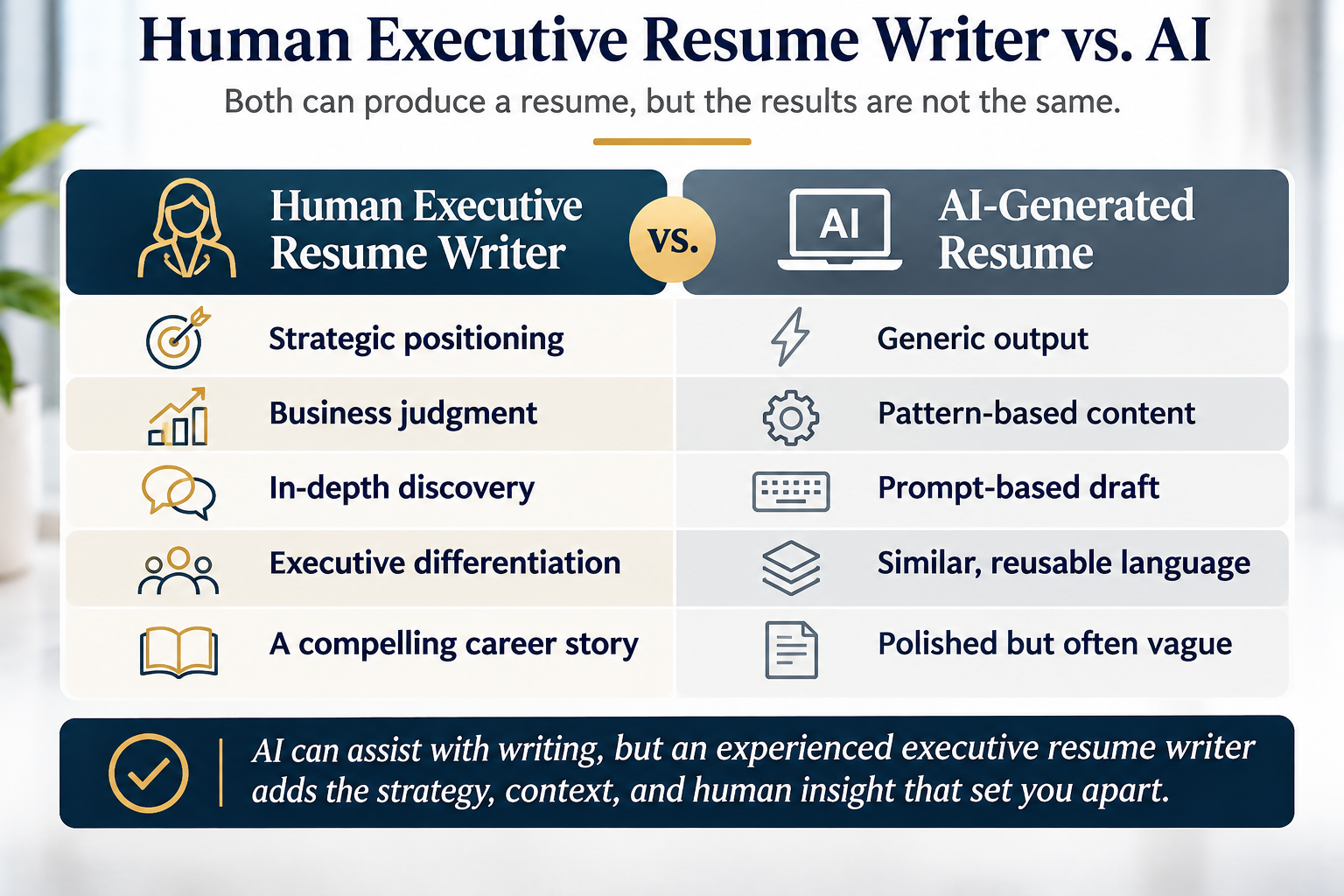
Artificial intelligence has changed the accessibility and speed of resume drafting. Tools such as ChatGPT can organize career histories, suggest keywords, compare documents with job descriptions, revise sentence structure, and generate professional-sounding language quickly. These capabilities can be useful, especially when an individual already understands their positioning and can critically evaluate the result. At the executive level, however, the most difficult task is usually not producing text; it is deciding what the text must accomplish.
Where AI Can Help
AI can assist with organizing notes, spotting inconsistent terminology, suggesting ways to simplify dense language, identifying topics worth researching, and examining how closely a draft addresses a stated job requirement. It can also support brainstorming and help a writer review multiple versions of a summary. In that sense, AI is a tool that can improve efficiency rather than an automatic substitute for professional judgment.
Yet AI-generated material must be verified carefully. A model may introduce unsupported claims, overstate an executive’s role, misunderstand industry context, or default to broad leadership clichés. Privacy and confidentiality are also significant concerns. Executives should not share proprietary strategies, nonpublic financial information, confidential client details, or other sensitive material with an AI system without appropriate safeguards and authorization.
What Experienced Writers Contribute Beyond AI
An accomplished executive resume writer can ask why a decision was made, what alternatives were considered, what constraints shaped the outcome, and how the result changed the organization. These details often determine whether an achievement is routine or remarkable. A writer also brings an outside perspective, helping the executive recognize valuable experiences that have become too familiar to seem noteworthy.
Professional judgment involves understanding business context, selecting the right evidence, and aligning that evidence with a target role. A résumé can call someone an accomplished transformation leader, but a stronger document explains the transformation’s scale, the leader’s actual contribution, and the results. The difference is not simply better word choice; it is deeper analysis and more accurate positioning.
AI can help write sentences. A skilled writer helps determine which story deserves to be told.
AI in Recruitment Does Not Eliminate Human Evaluation
Recruiting organizations may use AI to write job descriptions, search candidate databases, communicate with applicants, or support resume review. Adoption differs by employer, industry, and position level, so candidates should not assume that every resume is screened in the same way. Nor should they assume that repeated keywords or a particular optimization score will secure an interview.
The more defensible approach is to create a document that accurately communicates relevant experience, incorporates recognizable terminology, and presents credible evidence of business and leadership impact. Technology should support that strategy rather than replace it. For a related discussion, see The Right Way to Use AI for Executive Resume Writing.
Are Executive Resume Writing Services Worth the Cost?
Professional executive resume writing can represent a meaningful investment, particularly when an engagement includes multiple documents and extensive strategic work. Prices vary with the writer’s experience, the complexity of the career history, the number of deliverables, and the degree of direct involvement. Basic editing is not equivalent to an in-depth executive branding engagement, and comparisons based solely on price may overlook substantial differences in what clients receive.
A comprehensive engagement may involve discovery interviews, research, positioning, writing, design, LinkedIn development, biographies, networking documents, and collaborative revisions. Executives should evaluate the value of the process and the qualifications of the person performing it. The goal is to obtain clear, credible career materials that support the next move—not merely a more attractive version of an old resume.
What Influences the Price?
- Professional experience: Extensive C-suite work, advanced credentials, and a developed portfolio may support higher fees.
- Discovery and research: Complex careers take time to understand and organize.
- Positioning strategy: Determining the strongest narrative requires analytical work beyond editing.
- Writing and presentation: Effective executive documents combine substance, clarity, and visual judgment.
- Supporting deliverables: LinkedIn, biographies, recruiter correspondence, and coaching expand the scope.
- Individualized attention: Boutique firms may limit their client volume to support direct involvement.
Can a Professional Resume Writer Guarantee Interviews?
No writer can control every factor influencing a hiring decision. Economic conditions, competition, networking activity, compensation expectations, location, interview performance, and internal company decisions all shape the outcome. A professionally developed resume can improve how an executive’s qualifications are communicated, but it cannot guarantee interviews, offers, promotions, or salary increases.
Executives should be cautious about aggressive placement claims or impressive-sounding statistics without clear methodology. The value of executive resume writing lies in sharper positioning, credible storytelling, and professionally developed career materials—not promises of employment.
Warning Signs When Evaluating Top Executive Resume Writing Services
Not every firm advertising executive resume writing has the specialized experience required to manage senior leadership careers. Some warning signs are obvious, while others become apparent only after prospective clients ask questions about the process, the people involved, or the meaning of advertised results.
- Unverifiable ranking claims: Claims of being the number-one provider without a clear source or methodology.
- Weak or missing writing samples: Little evidence of substantive executive-level writing.
- Generic intake procedures: Dependence on automated questionnaires without meaningful discovery.
- Unclear writer assignment: No transparency about who develops and writes the documents.
- Exaggerated guarantees: Promises of interviews, job offers, or salary increases beyond the firm’s control.
- Keyword stuffing: Repeated phrases substituted for a coherent leadership narrative.
- One-size-fits-all branding: Similar summaries and designs applied to executives with very different backgrounds.
- Unclear pricing or revision policies: Limited information about what the engagement actually includes.
These concerns do not mean an organization must be large, small, highly priced, or award-winning to produce excellent work. They do suggest why careful vetting matters. A productive professional relationship begins with transparent expectations and a shared understanding of what the finished materials must accomplish.
Choosing the Best Executive Resume Writer for Your Career Situation
The right writer depends in part on what the executive hopes to accomplish. A person pursuing a first enterprise-wide role may need different positioning from a sitting CEO seeking a board seat, a technology executive changing sectors, or an operating leader exploring private equity-backed opportunities. Broad executive experience helps, but relevant experience with the specific transition can be equally important.
CEOs and C-Suite Candidates
Senior leaders pursuing enterprise positions need materials demonstrating business growth, profitability, capital stewardship, major decisions, organizational transformation, and strategic leadership. The writer must distinguish the executive from competitors who may have equally prominent titles and backgrounds. A clear account of the individual’s contribution matters more than a long list of responsibilities.
Senior Vice Presidents Preparing for the C-Suite
Moving from functional leadership to broader enterprise accountability requires a shift in perspective. The resume should bring forward cross-functional influence, strategic judgment, enterprise-wide initiatives, and business impact rather than depending entirely on the size of a team or budget. Evidence of readiness for wider responsibility needs to be explicit and credible.
Executives Changing Industries
Industry transitions call for a thoughtful interpretation of transferable accomplishments. A writer can connect experience in transformation, operations, growth, risk, people leadership, or technology to the priorities of a new sector. The objective is not to disguise the candidate’s previous industry but to show why that experience offers relevant value in the new one.
Private Equity-Backed Leadership Opportunities
Searches involving private equity may place particular emphasis on value creation, cash flow, operational discipline, performance improvement, growth execution, and transaction readiness. Accomplishments should be connected to business outcomes and investor priorities without overstating the executive’s individual influence. A writer familiar with those expectations can help build a more focused case.
International Executives
Executives with multinational careers may need to explain cross-border operations, geographically distributed teams, international market development, and leadership across regulatory and cultural environments. A writer experienced in global careers can help clarify the scale of these responsibilities for recruiters and hiring committees in the intended market.
The Value of Specialized Board Resume Writers
Board resume writing requires a different lens from traditional executive career marketing. An exceptional operating leader may have extensive strategic expertise without previously serving as an independent director. The writer’s task is to identify which experiences demonstrate governance-relevant judgment and to communicate them without implying board experience the candidate does not possess.
Board-focused resumes and biographies may emphasize:
- Enterprise strategy and long-term value creation.
- Financial oversight, capital allocation, and audit awareness.
- Risk management, cybersecurity, and compliance.
- Governance experience and interaction with boards or committees.
- Mergers, acquisitions, and corporate transactions.
- Executive succession and human capital oversight.
- Industry knowledge, innovation, and organizational resilience.
A strong board document explains what perspective and expertise the individual can contribute to boardroom discussions. It is less concerned with documenting every operational responsibility than with showing the candidate’s ability to support oversight, strategic direction, and long-term organizational interests. Executives interested in this path can explore Board Resume Writing and Branding Services.
What to Expect When Working with a Professional Resume Writer
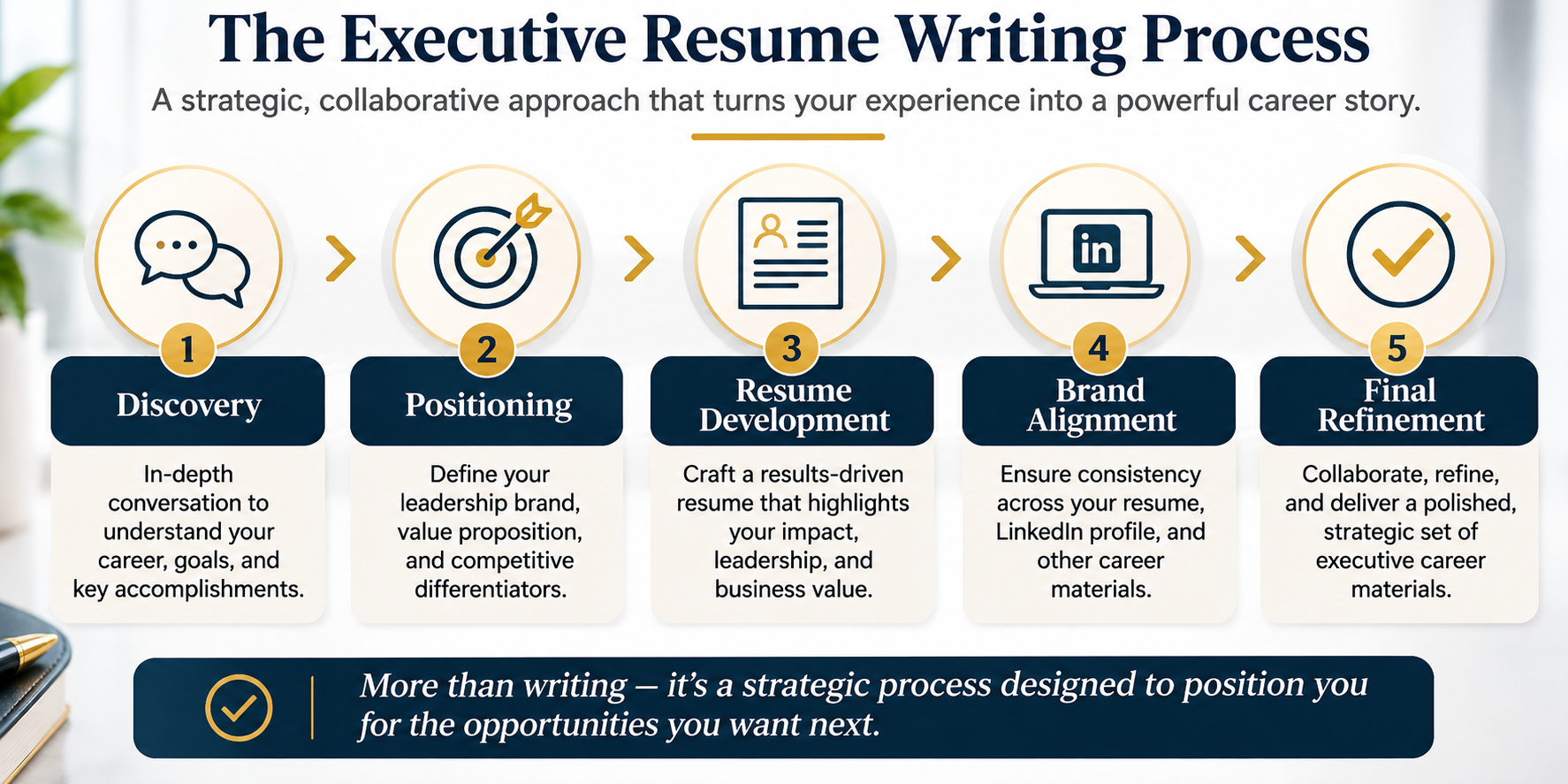
A comprehensive executive branding engagement typically follows a structured process, although individual providers differ in how much contact and strategic support they offer. Executives should understand these stages before selecting a service, particularly when several documents must be coordinated.
Initial Consultation and Goals
The writer learns about the executive’s background, intended positions, timing, and immediate concerns. This discussion also helps determine whether the writer’s experience and service model fit the client’s needs. A good consultation should provide clarity about next steps, not merely introduce a price.
Executive Discovery and Research
The writer reviews existing career materials and explores leadership achievements in greater depth. Thoughtful questions may reveal overlooked accomplishments, relevant financial outcomes, and defining decisions. The quality of this discovery often shapes the quality of the final narrative.
Positioning and Brand Development
The writer identifies themes that connect the executive’s past performance to future opportunities. This includes determining what should lead the resume, which achievements merit detail, and how to organize the career history to support the intended message.
Resume Development and Collaboration
The initial resume turns the strategy into a document that is coherent, accurate, and easy to use. The executive then reviews the content for authenticity and completeness, and collaborative revisions refine the work. When LinkedIn profiles, biographies, or other materials are included, they should reinforce the same core positioning without repeating every sentence.
Career Steering: An Established Boutique Executive Resume Writing Practice
Career Steering is an established boutique provider specializing in executive-level resume writing and career branding. Founded in 2003, the firm serves C-suite leaders, senior executives, board candidates, and professionals making significant career transitions. Its founder, Rosa Elizabeth Vargas, combines extensive writing experience with career coaching, business insight, and a personally led approach to executive positioning.
Vargas holds five advanced credentials: Certified Master Resume Writer (CMRW), Master Resume Writer (MRW), Nationally Certified Resume Writer (NCRW), Academy Certified Resume Writer (ACRW), and Certified Career Management Coach (CCMC). Her professional recognition includes TORI resume writing awards and nominations, career industry publications, and participation in professional resume writing organizations. She has also contributed career advice through the Forbes Coaches Council.
A Founder-Led Approach to Executive Resume Writing
Career Steering distinguishes its practice through personal involvement in executive discovery, positioning, and writing. Rather than assigning a client’s career story to a rotating pool of writers, Vargas directs the strategic process and the core writing for each engagement. Support staff may assist with research, proofreading, design, or project coordination, but the central brand strategy and narrative remain founder-led.
The firm’s services include executive resumes, LinkedIn optimization, executive biographies, board branding, coaching, and more comprehensive career marketing packages. Prospective clients can compare executive resume writing services and pricing, examine professional executive resume samples, or read more about Rosa Elizabeth Vargas as an executive resume writer.
Career Steering reports that much of its business comes through referrals, repeat clients, and professional recommendations. As with any provider discussed in this guide, executives should evaluate the firm’s qualifications, samples, service structure, and engagement terms against their own needs. Because Career Steering publishes this article, its inclusion is disclosed rather than presented as an independent award or objective ranking.
Frequently Asked Questions About Top Executive Resume Writers
Who are the top executive resume writers in 2026 and 2027?
There is no single, universally accepted ranking of the top resume writers. Established professionals and firms can be evaluated through executive-level experience, writing samples, certifications, industry recognition, business knowledge, client relationships, and service transparency. The most suitable writer depends on the executive’s intended opportunities, career background, and preferred working style.
Are the best resume writers certified?
Many accomplished writers hold designations such as CMRW, MRW, NCRW, ACRW, or CPRW. These credentials can demonstrate commitment to professional standards, but they do not automatically guarantee strategic executive writing expertise. Readers should review certifications alongside actual writing samples and experience with comparable career situations.
Is an executive resume writer worth hiring if the executive is already a strong writer?
Potentially. Many senior executives communicate exceptionally well, but an external specialist can contribute objective perspective, experience with executive marketing, and an understanding of which accomplishments matter to a target audience. The value may lie more in positioning and analysis than in correcting the writing itself.
Can ChatGPT write a good executive resume?
AI can assist with brainstorming, organization, editing, and keyword review. Its output, however, depends on the detail and accuracy of the information supplied, and it may produce generic language or unsupported claims. Executive-level work benefits from careful fact-checking and strategic decisions about the message, audience, and evidence.
Do executive resume writers help with LinkedIn?
Many do. Services can include executive headlines, About sections, experience descriptions, search terminology, and professional positioning. A LinkedIn profile should support the executive’s brand without merely reproducing the resume in full.
Can an executive resume writer help with board opportunities?
Writers experienced with board positioning can help translate relevant operating accomplishments into governance-oriented expertise. Board resumes and biographies often emphasize oversight, strategic judgment, enterprise risk, capital stewardship, and the perspectives a candidate can bring to board discussions.
How long does executive resume writing take?
Turnaround depends on the complexity of the career, the provider’s process, the number of deliverables, and the client’s availability for discovery and revisions. A comprehensive branding engagement may take several weeks, particularly when multiple documents and collaborative review stages are involved.
Can a professional resume writer guarantee a job?
No. Even an excellent resume cannot guarantee an interview, offer, promotion, or salary increase. Hiring decisions depend on market conditions, available roles, candidate competition, networking, interviews, and factors beyond the writer’s control. Credible providers focus on the quality and strategic usefulness of the materials they develop.
The Bottom Line: Choosing Among the Top Executive Resume Writers
The search for the best executive resume writer should begin with substance rather than rankings. Certifications, awards, polished websites, and favorable reviews may help establish credibility, but they do not replace the need to evaluate the writer’s actual work, business judgment, personal involvement, and ability to understand the executive behind the resume. The most effective documents are carefully positioned, supported by credible achievements, and developed around the problems a leader is qualified to solve.
In a recruiting environment shaped by AI-assisted applications, changing hiring technology, and competition among highly accomplished leaders, strategic differentiation remains essential. The best executive resume writer is not necessarily the one making the loudest claim. It is the professional who can recognize the value of an executive’s experience and communicate it with clarity, credibility, and purpose.
Executives interested in Career Steering’s boutique approach can contact Rosa Elizabeth Vargas to discuss career goals, available services, and appropriate next steps.
Rosa Elizabeth Vargas
Certified Master Resume Writer | Executive Career Brand Strategist | Certified Career Management Coach
Phone: 321.704.7209 | Email: writer@careersteering.com
Explore Executive Resume Writing Services & Packages | Review Executive Resume Writing FAQs | View Executive Resume Samples