Leveraging Visual Storytelling in Executive Resumes
In executive resume writing, the goal is not simply to document responsibilities; it is to communicate leadership impact.
Executives operate in complex environments where strategy, transformation, and measurable outcomes matter far more than task-based e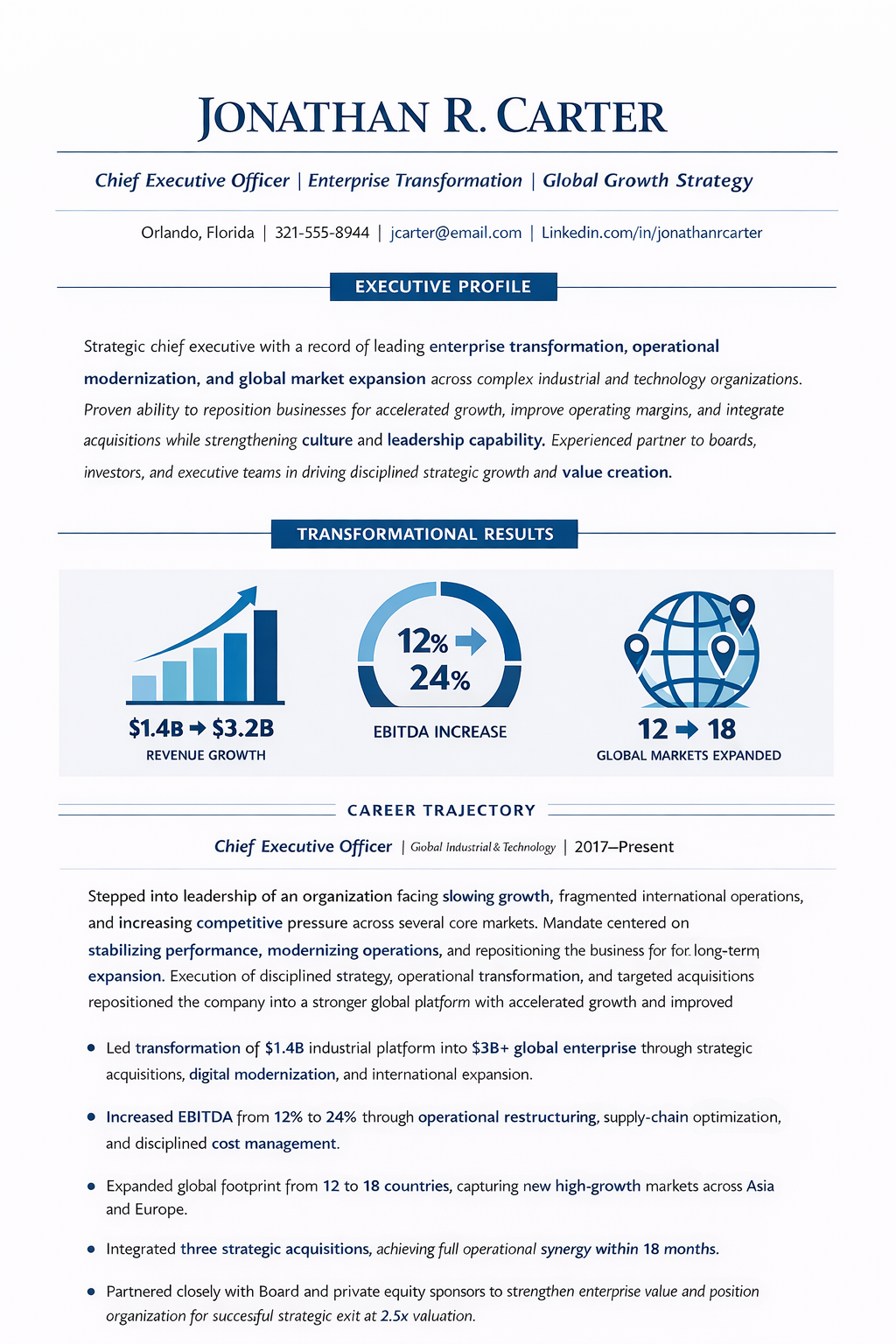 xecution. Yet many executive resumes still rely on dense paragraphs and detailed bullet points that describe activity rather than influence. One of the most effective ways to elevate a leadership narrative is by integrating a well-designed visual element, such as a strategic infographic or performance chart, while simultaneously refining the written content to focus on outcomes, organizational transformation, and business impact. When done correctly, the result is a resume that is both more compelling and more aligned with how executives actually lead.
The examples below illustrate how strategic visual elements can strengthen an executive resume. By incorporating a concise infographic or performance illustration directly within the document, key outcomes such as revenue growth, operational transformation, or market expansion can be communicated instantly. These visuals act as anchors for the reader, highlighting the scale and significance of results while the surrounding narrative focuses on leadership impact. The goal is not decoration, but clarity that helps decision-makers quickly understand the scope of the executive’s contributions and the measurable outcomes achieved.
Executive Resumes Have Evolved
Traditional executive resumes often fail because they attempt to capture the full scope of a leader’s responsibilities rather than distilling the strategic outcomes of their leadership. The result is a document that reads more like a job description than a leadership narrative. Long blocks of text and heavily detailed bullet points may communicate effort, but they rarely communicate influence.
Boards, private equity partners, and executive recruiters are not evaluating whether a leader managed meetings, oversaw departments, or executed processes. They are evaluating whether that leader transformed organizations, accelerated growth, stabilized operations, improved margins, or repositioned businesses for long-term success. An effective executive resume, therefore, requires a shift away from documenting activity toward presenting evidence of leadership impact.
A carefully designed visual element can help accomplish this shift. Strategic infographics, such as revenue growth charts, transformation timelines, operational improvement visuals, or market expansion illustrations, allow key achievements to be communicated immediately and clearly. Executives often lead initiatives that span multiple years, involve complex organizational change, or generate significant financial impact. A visual representation can distill that complexity into a single, digestible snapshot that highlights the scale of results.
When integrated thoughtfully into the executive resume, these visuals do not replace the written narrative; rather, they reinforce it. They draw the reader’s attention to the outcomes that matter most while creating a document that is more engaging and easier to absorb.
Once a visual element highlights the central achievements, the written narrative can become far more disciplined. Rather than relying on long, descriptive bullet points that walk through process or responsibility, the content can be streamlined to emphasize outcomes, transformation, and leadership influence. This means prioritizing statements that demonstrate how the executive reshaped organizations, drove growth, led change, or improved performance. In many cases, several lines of operational detail can be distilled into a single, sharper statement that communicates both the result and the business impact.
The goal is not to remove substance, but to remove noise, allowing the most meaningful achievements to stand out with clarity and authority.
Leveraging The Power of Design for the Right Audience 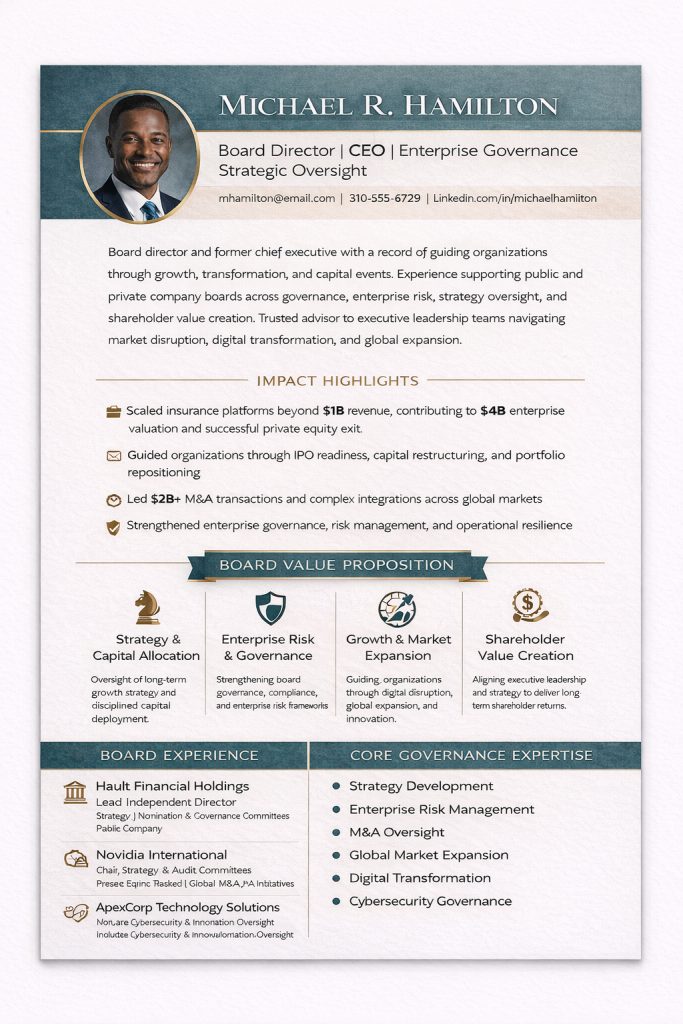

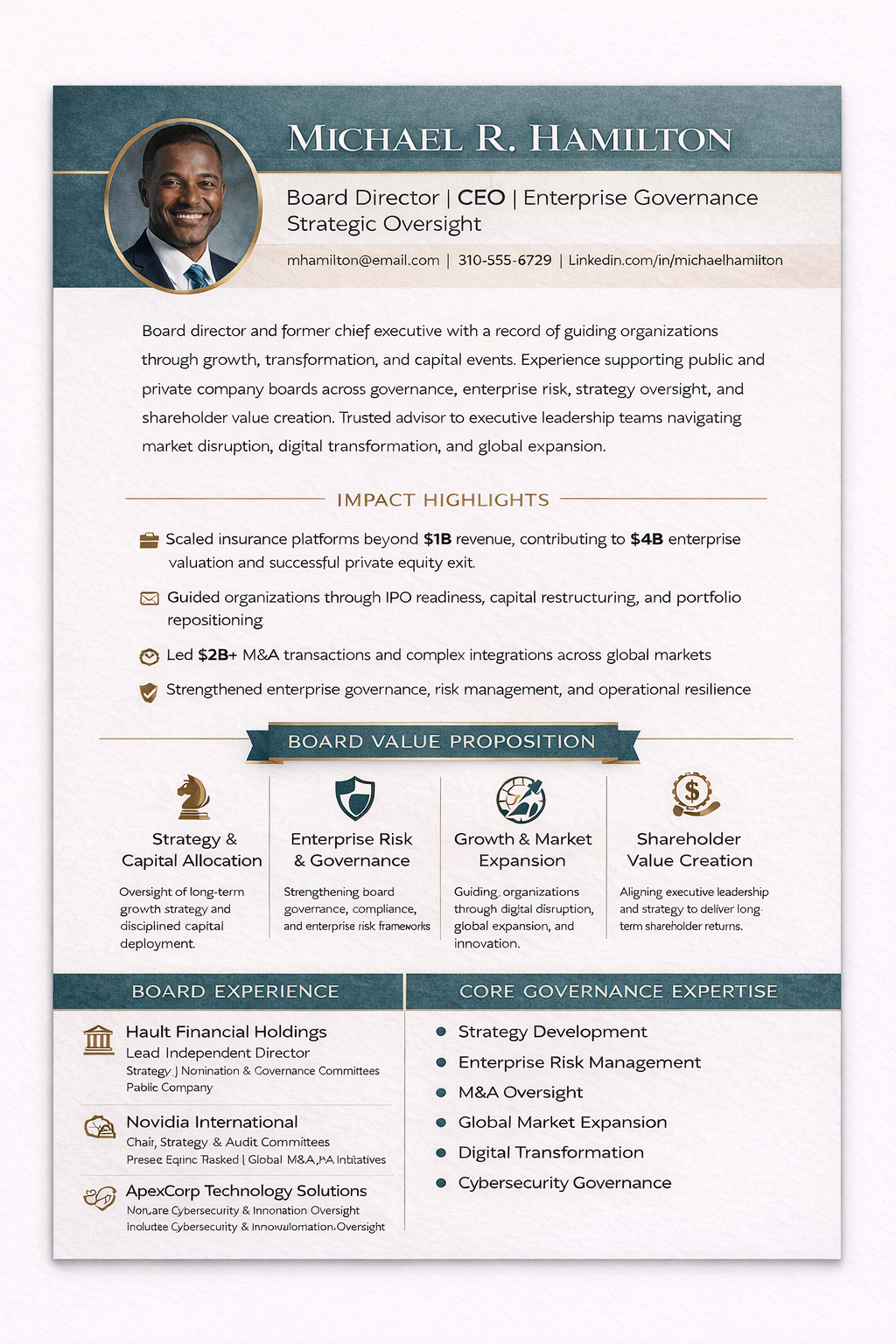
This approach also reflects how executive recruiters and board members actually read resumes. They are not studying every line in sequence; they are scanning for signals of scale, complexity, and results. A resume that combines concise impact statements with a strategically placed visual anchor allows the reader to quickly grasp the scope of leadership and the magnitude of outcomes delivered.
In a matter of seconds, the document begins to tell a clear story: what the organization looked like before the leader arrived, what transformation occurred under their leadership, and what measurable results followed. The visual and narrative elements work together to guide the reader’s attention toward the most compelling evidence of executive performance.
While visual elements can significantly strengthen an executive resume by highlighting scale, outcomes, and transformation at a glance, they must be used thoughtfully and strategically. Today’s application technologies and modern applicant tracking systems are far more sophisticated than many realize and can interpret embedded graphics and visual elements in many formats.
That said, the executive job search is inherently multidimensional. At Career Steering, we ensure our clients are equipped with multiple versions of their resume, visually enhanced presentations for networking and direct recruiter engagement, along with optimized formats designed for seamless ATS compatibility. Understanding how and when each format should be used is an important part of navigating the executive job market effectively.
It is also important to understand that more visually structured resumes, such as the examples shown here, often function as networking resumes. These formats combine concise narrative with selective infographic elements to communicate leadership impact quickly when shared in conversations, introductions, or direct outreach to decision-makers. In executive search, many opportunities still emerge through relationships, referrals, and targeted networking rather than through online applications alone.
For that reason, these visually enhanced resumes can be powerful tools when circulating materials among board members, recruiters, investors, and professional contacts.
At the same time, executive resume development should always account for the multiple channels through which opportunities arise. Online applications, direct outreach to organizations, networking introductions, and recruiter engagement may each call for slightly different resume formats. A more traditional resume—presented in a clean, modern format without visual elements remains appropriate in certain situations, particularly when submitting through structured systems.
Executive branding, in essence, is marketing. The goal is not to choose one style over another, but to use the right presentation for the right context.
At the executive level, the resume is not merely a record of experience; it is a strategic narrative that communicates the scale, transformation, and value a leader brings to an organization.