Most executives walk into interviews overprepared… and still under-positioned.
They bring a traditional resume. They answer questions well. They talk through experience.
And yet, they leave the conversation having blended in rather than stood out.
This is where a networking resume changes everything.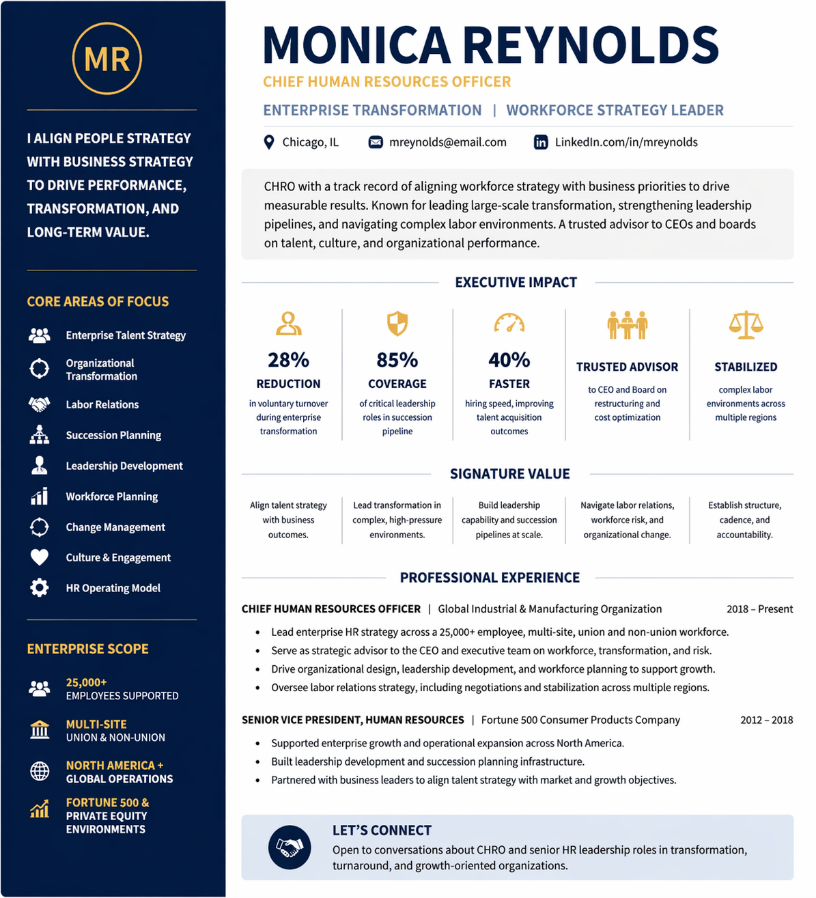
A networking resume is not designed to get you through applicant tracking systems. It is not designed to check boxes. It is designed to control the narrative in a live conversation to position you as a peer, not a candidate.
And when used correctly, it becomes one of the most powerful tools you can bring into an interview.
Shift from “Answering Questions” to “Leading the Conversation”
Most candidates allow the interviewer to dictate the flow. They respond. They elaborate. They follow.
A networking resume allows you to shift that dynamic.
Instead of reacting, you anchor the conversation around how you create value.
When you walk into an interview with a clean, visually compelling, highly curated networking resume, you are signaling something immediately:
You are not here to walk through your past.
You are here to discuss how you operate and what you deliver.
This subtle shift changes perception. You are no longer being evaluated linearly. You are being engaged strategically.
Use It as a Visual Talk Track
A well-constructed networking resume is not meant to be read top to bottom. It is meant to be used.
Think of it as your executive briefing document.
- Your Executive Impact section becomes your headline narrative
- Your Signature Value becomes your positioning language
- Your metrics and scope reinforce scale without explanation
Instead of trying to remember what to say, you guide the conversation visually.
“Let me show you how I typically operate in transformation environments…”
“Here are a few outcomes that are most relevant to what you’re describing…”
Now you are not searching for examples. You are pointing to proof.
Reinforce Executive Presence Without Saying a Word
There is a difference between telling someone you are strategic and showing it.
A networking resume does the latter.
The structure, the clarity, the brevity, the emphasis on outcomes…all of it communicates how you think.
It tells the interviewer:
- This person understands business, not just function
- This person can synthesize complexity quickly
- This person operates at an enterprise level
Before you’ve even answered a question, your positioning is already elevated.
Control What They Remember
Interviews are not won on volume. They are won on clarity and recall.
After a full day of conversations, most candidates blur together. Titles sound similar. Stories overlap.
A networking resume gives the interviewer something different to hold onto.
Clear metrics. Distinct positioning. Memorable structure.
Instead of “the HR leader from Chicago,” you become:
“The CHRO who reduced turnover 28% during transformation and built leadership coverage across 85% of the organization.”
That is what gets repeated in internal conversations.
Use It Selectively and Intentionally
This is not a document you submit online. It is not something you lead with in every interaction.
It is a strategic tool.
Bring it into:
- Second-round and final interviews
- Executive-level conversations
- Networking meetings that have hiring potential
Introduce it naturally:
“I put together a brief executive summary to highlight how I approach this kind of work—happy to walk through it if helpful.”
That positioning matters. You are not handing over a resume. You are offering insight.
The Bottom Line
At the executive level, interviews are not about qualifications. Those are assumed.
They are about confidence, clarity, and perceived impact.
A traditional resume tells your story.
A networking resume positions your value.
And when used correctly, it does something most candidates never achieve:
It allows you to walk into the room not as someone hoping to be chosen,
but as someone already operating at the level they are hiring for.