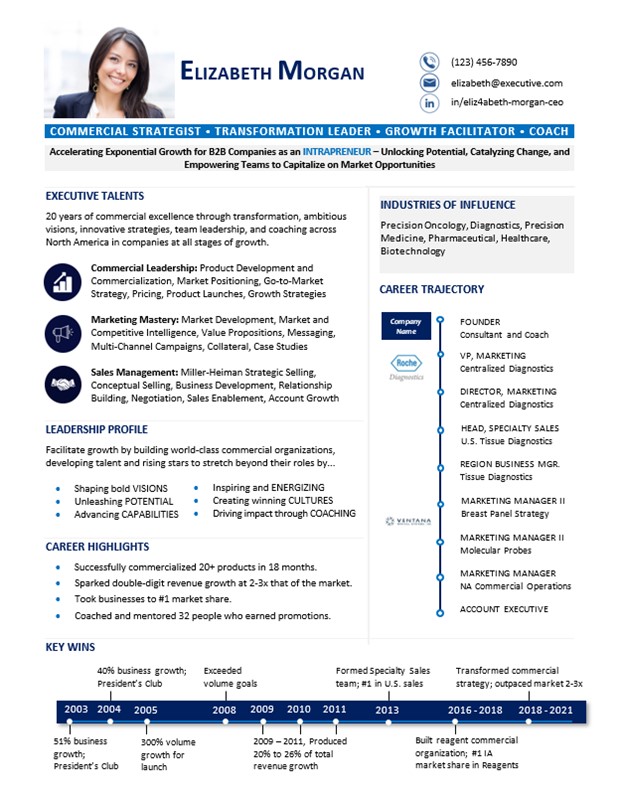
CEO Careers Are Rarely Linear
No single CEO career path exists, and no single formula should apply to writing a CEO resume.
Some executives have led multiple companies across different industries, ownership structures, and growth stages. Others are preparing to pursue their first CEO opportunity after years as a President, COO, CFO, divisional leader, or other senior executive.
Some are navigating a transition that requires particularly thoughtful positioning.
I work with executives across these different career inflection points.
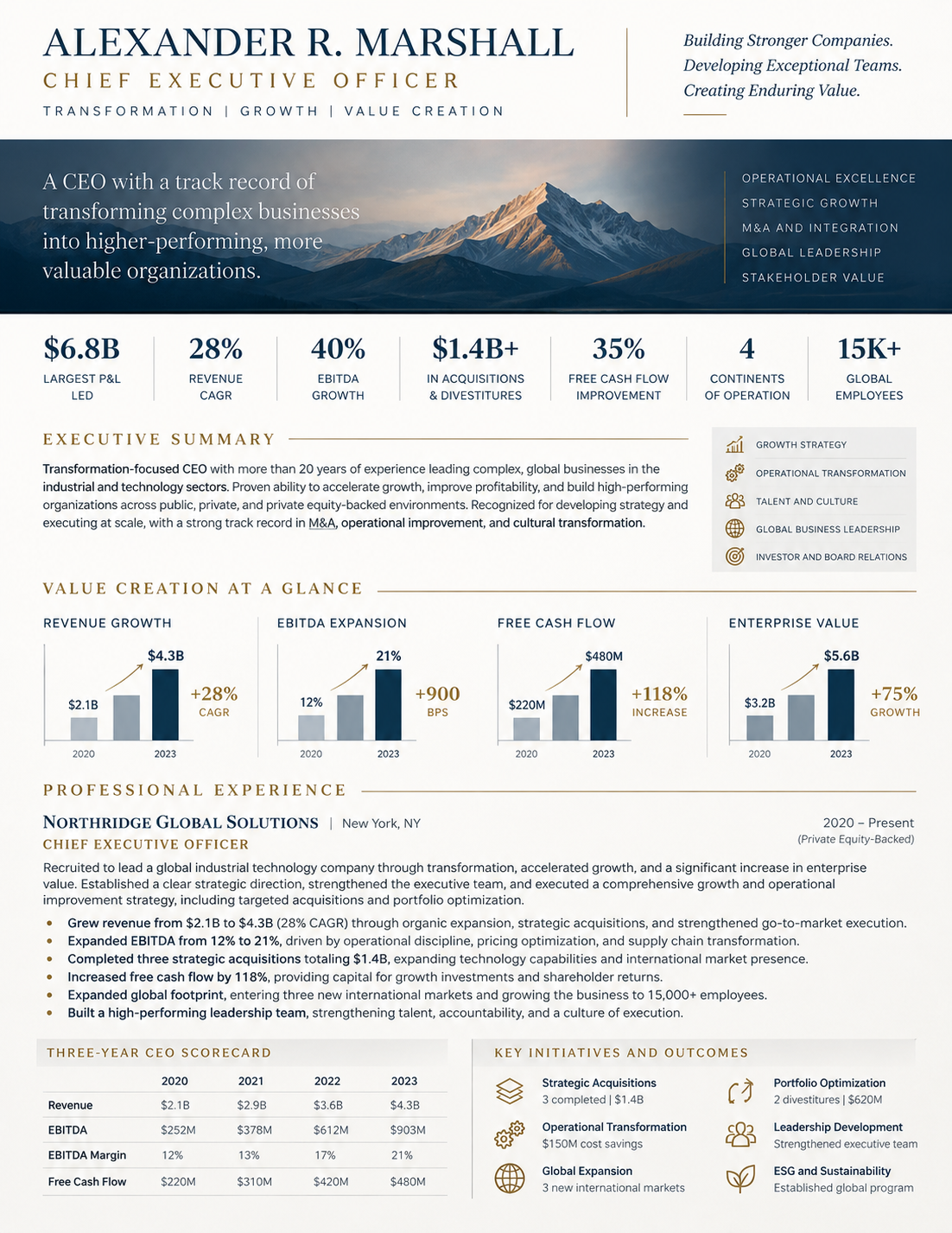
Already a CEO, But the Story Has Become Complex?
Perhaps you have served as CEO of several companies. You may have moved between public, private, founder-led, family-owned, or private equity-backed organizations. Some assignments may have been growth mandates; others may have involved turnarounds, restructurings, integrations, exits, or difficult market conditions.
The challenge is often not a lack of experience. It is making a complex career make sense.
Your resume needs to connect those chapters and reveal the leadership thread running through them. Why were you selected? What mandate did you inherit? What did you change? What value did you create?
What does the cumulative experience position you to do next?
Transitioning to a Different CEO Opportunity?
A CEO moving from a middle-market company to a larger organization, from private to public, from corporate leadership to private equity, or from one industry to another cannot rely on title alone.
The resume must help decision-makers see the transferability and scale of your leadership. That may mean repositioning accomplishments around transformation, value creation, organizational complexity, capital allocation, growth, governance, stakeholder leadership, or another capability that travels beyond a particular company or industry.
The objective is not to disguise the transition. It is to make the logic behind it clear.
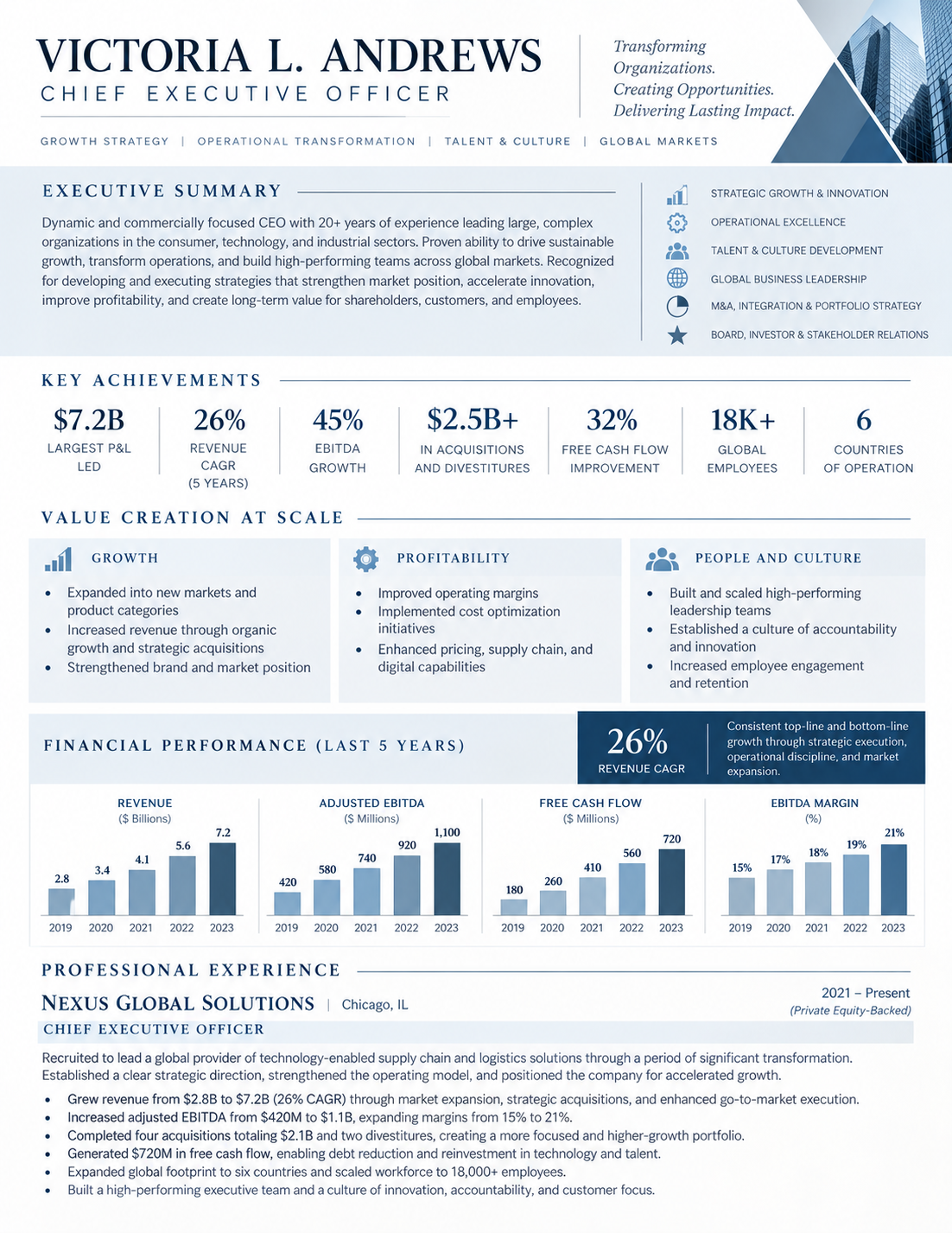
Pursuing Your First CEO Role?
Becoming a CEO does not begin when the title appears on your resume.
Often, the evidence has been accumulating for years. You may already be setting strategy, owning a substantial P&L, leading an operating company or business unit, working with boards and investors, making capital decisions, building executive teams, navigating transformation, or carrying responsibilities that extend well beyond your functional title.
For a President, COO, CFO, SVP, General Manager, or other senior executive pursuing a first CEO position, I look for that evidence. Then we reposition the career around CEO readiness without overstating the title you hold today.
The resume should help the reader see the progression: increasing scope, broader decision-making authority, greater business accountability, and a demonstrated ability to lead through the kinds of challenges CEOs are hired to solve.
Navigating a Difficult Career Chapter?
Not every CEO tenure ends with a perfect upward trajectory.
Companies are sold. Boards change direction. Private equity sponsors exit. Markets contract. Businesses restructure. Leadership teams turn over. Strategies change. Sometimes a CEO is brought in specifically to make difficult decisions during an extraordinarily difficult period.
Those circumstances require context, judgment, and careful positioning. I do not believe in trying to write around the complicated parts of an executive career. I work to understand them.
Then we determine what belongs on the resume, what requires context, what demonstrates leadership under pressure, and how the complete career story supports the opportunity you are pursuing next.
The Resume Has to Make the Next Move Make Sense
Whether you are pursuing another CEO mandate, stepping into a larger organization, changing industries, entering a private equity environment, returning to the market after a transition, or positioning yourself for your first CEO appointment, the resume must answer an essential question:
Why does your career make sense for what you want to do next?
That answer is different for every executive.
And that is precisely why I don’t begin a CEO resume with a template. I begin with the career.
I’ve Worked With CEOs Across Companies, Industries, and Career Chapters
Over more than 20 years of executive resume writing and career strategy, I have worked with CEOs and senior executives leading organizations of very different sizes, structures, and stages of growth.
My clients have led publicly traded and privately held companies, private equity portfolio businesses, entrepreneurial and founder-led organizations, family businesses, nonprofits, healthcare organizations, technology companies, global enterprises, and complex operating divisions within larger corporations.
Some have managed businesses measured in millions. Others have carried responsibility for multibillion-dollar organizations, global workforces, extensive operating footprints, and highly complex stakeholder environments.
Yet size alone rarely tells the most interesting part of the story.
I have worked with CEOs brought in to accelerate growth, restore profitability, professionalize founder-led companies, integrate acquisitions, reposition businesses, build leadership teams, navigate ownership changes, prepare organizations for sale, expand internationally, modernize operations, and lead through periods of tremendous disruption.
I have also worked with executives between chapters.
A successful exit.
A company sale.
An unexpected transition.
A first CEO search.
A move into private equity.
A return to corporate leadership.
A shift into a different industry.
A CEO exploring board opportunities while determining what comes next.
Every situation creates a different positioning challenge.
Your Career Documents Should Be as Accomplished as the Career Behind Them
One of the most common problems I encounter at this level is a striking disconnect between the caliber of the executive and the caliber of the documents representing that executive.
The career may be extraordinary.
The resume often isn’t.
Years of increasingly complex leadership have been compressed into job descriptions, lengthy lists of responsibilities, disconnected accomplishments, and language that could describe almost any senior executive. That is particularly problematic for CEOs.
Your resume, LinkedIn profile, executive biography, and board materials should reflect the sophistication, scale, and substance of the career they represent.
They should communicate not only what you have done, but the leadership reputation you have built while doing it.
That requires more than stronger wording.
It requires executive branding.
Building a CEO Brand Without Manufacturing One
I don’t begin by deciding that you need a clever tagline.
I begin by understanding the evidence.
Across your career, what do people repeatedly trust you to do?
What kinds of businesses perform particularly well under your leadership?
What difficult situations have you learned how to navigate?
Where have you created disproportionate value?
What do boards, investors, founders, employees, customers, and other stakeholders rely on you for?
The answers begin to reveal your executive brand.
From there, I determine how that brand should carry across your CEO resume, LinkedIn profile, executive biography, board documents, and other career materials so that each document supports the same leadership story while serving its own purpose.
The goal is consistency without repetition.
And credibility without exaggeration.
Because at the CEO level, the strongest positioning usually isn’t invented.
It’s uncovered.
Ready to Talk About What Comes Next?
If your career has outgrown the resume that represents it, let’s talk.
Whether you are pursuing another CEO role, preparing for your first CEO appointment, navigating a transition, or simply realizing that your career materials no longer reflect the executive you have become, I would be happy to learn more about where you are headed.
Contact me for a confidential discussion, or review my executive resume writing services to explore the level of support that makes sense for you.
Rosa Elizabeth Vargas
321.704.7209